Middlesex County Dog Registration Information
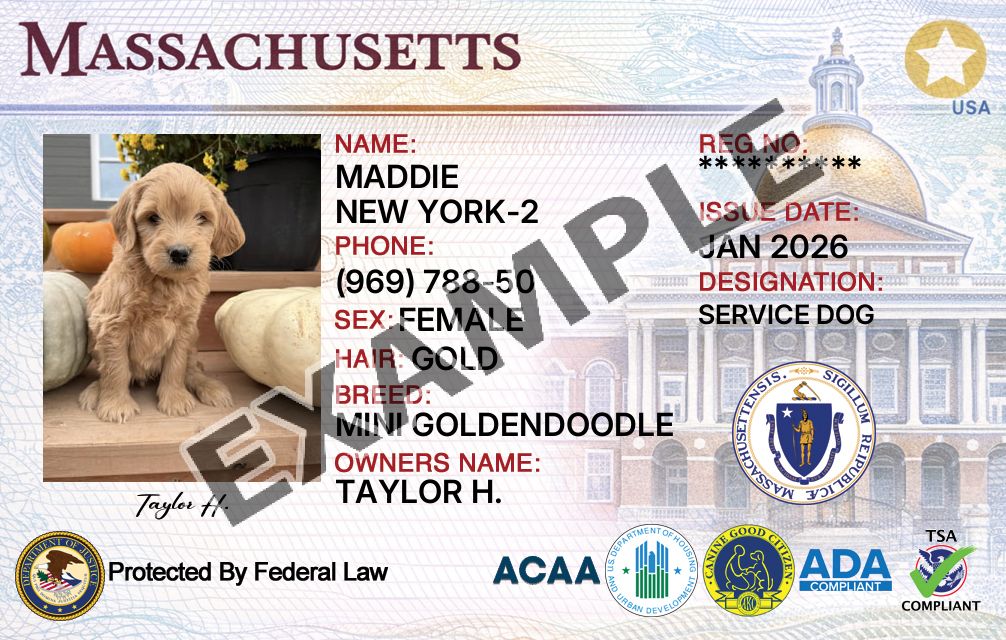
Service Dogs and Emotional Support Animals in Middlesex, Massachusetts
Where Do I Register My Dog in Middlesex County, Massachusetts for My Service Dog or Emotional Support Dog?
If you’re searching where do I register my dog in Middlesex County, Massachusetts for my service dog or emotional support dog, the key detail is this: in most communities, a dog license in Middlesex County, Massachusetts is handled by your local city or town (often the City/Town Clerk, Animal Control, or a similar municipal office), not by a single countywide licensing department.
This page explains where to register a dog in Middlesex County, Massachusetts, what you’ll need (especially rabies documentation), and how licensing differs from service dog legal status and emotional support animal (ESA) rules.
Where to Register or License Your Dog in Middlesex County, Massachusetts
Because Middlesex County includes many municipalities, dog licensing is usually done through the city/town where you live. Below are example official offices in Middlesex County, Massachusetts that handle dog licensing and/or animal control inquiries. If your town is not listed, look for your local “City Clerk,” “Town Clerk,” “Animal Control,” or “Animal Commission” office.
Somerville — City Clerk’s Office (Dog Licensing)
| Office | City of Somerville — City Clerk’s Office |
|---|---|
| Address | 93 Highland Avenue, Somerville, MA 02143 |
| Phone | 617-625-6600 x4100 (or 311 from any phone in Somerville) |
| cityclerk@somervillema.gov | |
| Office hours | Mon–Wed 8:30am–4pm; Thu 8:30am–7pm; Fri 8:30am–noon |
Tip: Somerville also publishes Animal Control contact details for questions related to enforcement, lost pets, and safety.
Somerville — Animal Control Office (Questions & Animal Control Issues)
| Office | City of Somerville — Animal Control Office |
|---|---|
| In-person location | Somerville Police Department, 220 Washington Street (by appointment only) |
| Phone | 617-625-6600 x2190 |
| animalcontrol@somervillema.gov | |
| Office hours | Not listed on the referenced program page. |
For licensing transactions, Somerville directs residents to the City Clerk’s Office.
Lowell — City Clerk (Dog Licensing)
| Office | City of Lowell — City Clerk |
|---|---|
| Address | 375 Merrimack Street, 1st Floor, Room 31, Lowell, MA 01852 |
| Phone | 978-674-4161 |
| Not listed in the referenced contact block. | |
| Office hours | Mon, Wed, Thu 8am–5pm; Tue 8am–8pm; Fri 8am–noon |
Lowell’s dog licensing page explains required items like a valid rabies certificate and notes annual expiration.
Cambridge — Animal Commission (Dog Licensing & Animal Control)
| Office | City of Cambridge — Animal Commission |
|---|---|
| Address | 344 Broadway, Cambridge, MA 02139 |
| Phone | 617-349-4376 |
| animalcommission@cambridgema.gov | |
| Office hours | Not listed in the referenced overview snippet. |
Cambridge provides multiple ways to apply for a dog license (online, by mail, or in person).
Cambridge — City Clerk’s Office (General City Clerk Contact)
| Office | City of Cambridge — City Clerk’s Office |
|---|---|
| Address | 795 Massachusetts Ave., 1st Floor, Cambridge, MA 02139 |
| Phone | 617-349-4260 |
| Not listed as a visible email address on the referenced page. | |
| Office hours | Mon 8:30am–8pm; Tue–Thu 8:30am–5pm; Fri 8:30am–12pm |
In Cambridge, dog licensing is commonly handled through the Animal Commission; the City Clerk’s Office listing is included as a helpful official reference.
Which agency is “the county office” for dog licenses?
In practice, there usually isn’t one single “Middlesex County dog licensing office” for residents. Instead, dog licensing and most animal control dog license Middlesex County, Massachusetts questions start with your city or town clerk and/or your municipal animal control program. Massachusetts also supports municipal animal inspectors whose primary duty includes rabies control.
Overview of Dog Licensing in Middlesex County, Massachusetts
What “registering a dog” usually means
When people ask where to register a dog in Middlesex County, Massachusetts, they usually mean obtaining a local dog license. A dog license is a municipal registration that helps communities:
- Confirm rabies vaccination compliance (public health and rabies enforcement).
- Maintain owner contact information for lost pets and animal control calls.
- Apply local rules (leash laws, kennel limits, nuisance rules) consistently.
Massachusetts law requires a license for dogs over a certain age and generally requires proof of rabies vaccination before the licensing authority can issue the license. Local details (fees, renewal deadlines, where to apply, and whether you can do it online, by mail, or in person) vary by city or town.
Rabies vaccination requirements (why the paperwork matters)
Rabies rules are enforced through a combination of state law and local licensing practices. In Massachusetts, dogs (as well as cats and ferrets) that are 6 months of age or older must be vaccinated against rabies by a licensed veterinarian, with revaccination at the intervals recommended by the vaccine manufacturer. Your veterinarian typically provides a rabies vaccination certificate and tag information, and municipalities commonly require this certificate as part of the licensing process.
Do service dogs and ESAs need a municipal dog license?
In most cases, yes. A dog license is a local animal control/public health requirement. Service dog status (under disability law) and ESA status (primarily tied to housing rules) do not automatically replace municipal licensing requirements.
How Dog Licensing Works Locally in Middlesex County, Massachusetts
Step-by-step: how to get your local dog license
- Find your municipality’s licensing office. Start with your City/Town Clerk, Animal Commission, or local Animal Control program (your city’s website often lists “Dog License” under Clerk services).
- Confirm your dog’s rabies vaccine is current. Request a rabies certificate from your veterinarian (paper or digital) showing dates and expiration.
- Prepare proof documents. Many offices ask for proof of residency and a way to verify the dog’s description; some offer reduced fees for spayed/neutered dogs if documentation is provided.
- Submit the application and pay the fee. Options vary: online, by mail, or in person. Keep your receipt/confirmation.
- Receive and display the license tag. A collar tag helps animal control return a lost dog quickly and shows compliance if checked.
What if you moved within Middlesex County?
A common point of confusion is assuming a dog license in Middlesex County, Massachusetts automatically transfers between towns. Because licenses are usually municipal, if you move from one city/town to another (for example, from Somerville to Lowell), you should contact your new municipality’s licensing office to ask whether you must re-license there and how they handle prior records.
Who handles animal control and rabies enforcement?
Day-to-day enforcement is typically local (municipal animal control officers, animal inspectors, or designated public safety staff). Their responsibilities often include responding to bites, investigating rabies exposure risk, and working with public health protocols—one reason rabies documentation is tightly linked to licensing.
Service Dog Laws in Middlesex County, Massachusetts
What counts as a service dog (and what does not)
Under the Americans with Disabilities Act (ADA), a service animal is a dog that is individually trained to do work or perform tasks directly related to a person’s disability. The tasks must be connected to the disability (for example, guiding, alerting, retrieving, interrupting harmful behaviors, or other trained assistance).
This is different from a pet that provides comfort by its presence alone. Comfort alone does not make a dog a service dog under the ADA definition.
No official “service dog registration” is required for public access
For most public places covered by the ADA, staff generally cannot require special identification cards or training documentation for your service dog. While you may choose to carry records that help in daily life (vaccination records, emergency contact info, training notes), those records do not replace local licensing rules.
How service dog status relates to local licensing
Even if your dog is a legitimate service dog under the ADA, you generally still need to follow local public health and animal control requirements—such as a municipal dog license and rabies vaccination rules. In other words: service dog rights are about access and nondiscrimination; licensing is about community health and animal control compliance.
Emotional Support Animal Rules in Middlesex County, Massachusetts
What an emotional support animal (ESA) is
An emotional support animal is generally an animal that provides comfort or support that helps with a person’s emotional or mental health symptoms. Unlike service dogs, ESAs are not required to be individually trained to perform specific tasks related to a disability.
ESA rights are different from service dog rights
ESAs do not have the same broad public-access rights as ADA service animals in places like restaurants, stores, and other public accommodations. ESA rules most commonly come up in housing contexts, where documentation from a qualified health professional may be relevant.
How ESAs relate to dog licensing in Middlesex County, Massachusetts
Whether your dog is a pet, an ESA, or a service dog, the municipal licensing process often looks the same: you apply through your local clerk/animal office, provide rabies vaccination documentation, and pay the required fee. If you’re unsure which office to use, call your city/town clerk and ask: “Which office handles dog licenses and what rabies documents do you require?”
Frequently Asked Questions
Register A Dog In Other Massachusetts Counties
Select your county below to get started with your dog’s ID card. Requirements and license designs may vary by county, so choose your location to see the correct options and complete your pup’s registration.
- Barnstable County Dog Registration
- Berkshire County Dog Registration
- Bristol County Dog Registration
- Dukes County Dog Registration
- Essex County Dog Registration
- Franklin County Dog Registration
- Hampden County Dog Registration
- Hampshire County Dog Registration
- Norfolk County Dog Registration
- Plymouth County Dog Registration
- Suffolk County Dog Registration
- Worcester County Dog Registration